Blackpool Corporation Transport
Blackpool Corporation Transport can trace its ancestry to 1885 when the electric street tramway was opened by a private company. The Corporation exercised its right to take over the company in 1892 and added the Blackpool and Fleetwood Tramroad Company in 1920. In addition to the original Promenade route, trams now ran along Lytham Road, Central Drive, Talbot Road to Layton and Whitegate Drive/Waterloo Road through Marton, plus the newly acquired line to Fleetwood.
The first bus service started in 1921 linking Cleveleys tram stop with Thornton Railway Station – well outside Blackpool. The following year saw local bus services commence in Blackpool though these were often short and inefficient. The Layton and Central Drive tram routes were converted to buses as part of a modernisation plan which saw 115 new trams and 154 new buses arrive between 1933 and 1940 all featuring the trademark centre entrance favoured by legendary manager Walter Luff.
Further tram services were replaced by buses between 1961 and 1963 and the bus fleet now topped 180 – almost all Leyland Titan double deckers. From 1969 to 1975, 55 driver only AEC Swift single deckers replaced the older Leyland Titans allowing staff efficiencies to be achieved.
Local government reorganisation saw Blackpool Corporation become Blackpool Borough Council and the transport department became ‘Blackpool Transport’ in 1974 and by this time the fleet had dropped to 143 – as it had been before the 1960s tram route conversions reflecting reduced services and frequencies as bigger buses were now used and more people owned cars.
Blackpool 246
Blackpool’s familiar centre entrance trams dating from the 1930s were once accompanied by streamlined styled buses, very different from those that operated in other towns and cities in the UK. Indeed, so futuristic was the design that an icon, cast in stone, appears on Blackpool’s Town Hall to this day, symbolising the development of wheeled transport (see below).
The first Corporation motor buses ran in Blackpool in 1922 and were initially mainly single deckers. Double deckers became standard from 1932 prior to the arrival of Walter Luff as manager the following year. Luff’s influence on the tram fleet is legendary but from 1935-1940 he introduced 130 modern streamlined buses. Post war two batches of 50 double deckers were delivered between 1949 and 1951, of which 246 was one of the first batch arriving in December 1949.
Like the pre-war buses these were full fronted centre entrance Leyland Titans with bodies built in Blackpool by Burlingham. They were, however, built to the newly introduced maximum 8ft width (instead of the previous 7’6”) and could seat 54 passengers, slightly less than a standard rear entrance bus. Luff retired in 1954 and Blackpool started to specify more standard designs culminating in the PD3s of 1967/8. These replaced the 1949-1951 centre entrance buses and 246 was withdrawn in October 1967.
These unusual vehicles did not command much demand on the second hand market, so few saw further use. 246 was an exception, though it stayed within the family becoming a mobile mess room for the tram track ‘Permanent Way’ repair gangs. It ran in this role until 1974 often to be seen by the side of the tram tracks where repairs were undertaken, painted in an all-over green livery.
In early 1976 the bus passed to the ownership of Lister of Bolton (a bus dealer) who used it as an office for many years. 1989 saw the bus join the preservation world before being acquired by the Lancastrian Transport Group the following year. No. 246 is admittedly in a very poor condition and will require substantial reframing as part of its restoration. It returned to Blackpool in September 2004 after several years in store at the St. Helens Transport Museum and awaits extensive restoration work before it can operate again.
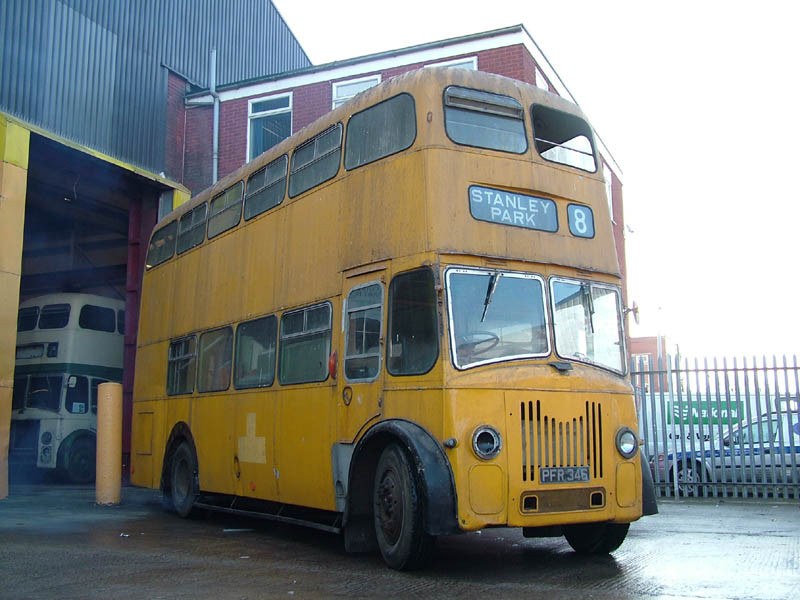
Blackpool 346
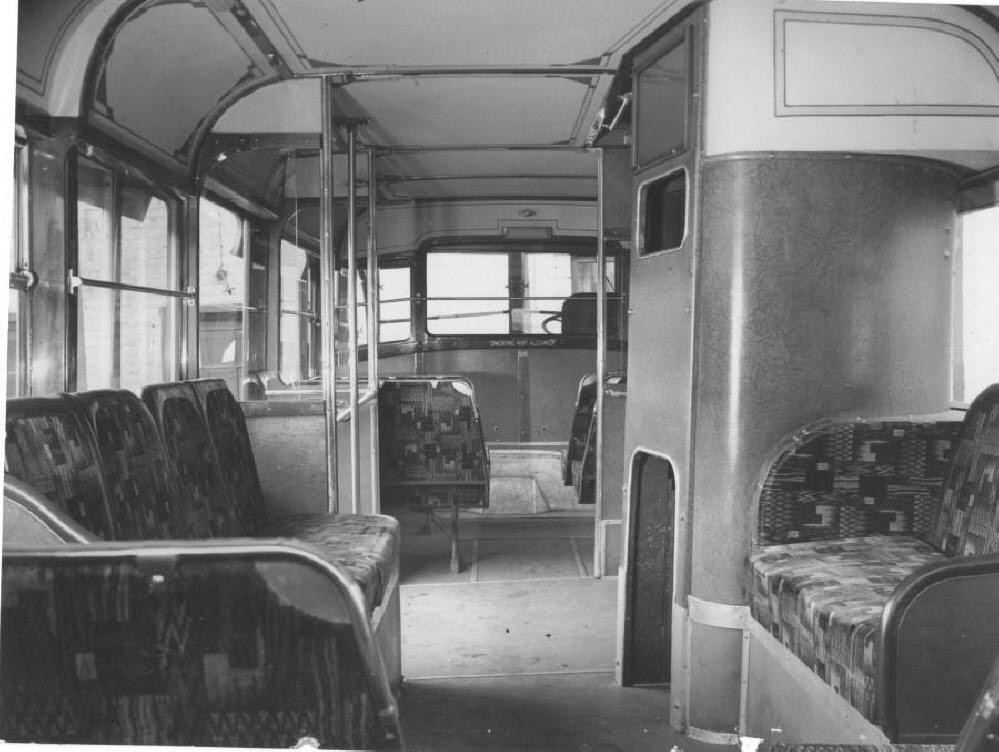
The tenure of Walter Luff as manager of Blackpool was characterised by flamboyant streamlined centre entrance vehicles, culminating in the Coronation tram and Streamline PD2s represented by 304 and 246 in our collection. Luff retired in 1954 and was replaced by Joe Franklin. While Franklin continued to innovate around the tram fleet, his approach to the buses was to adopt more standard vehicles. His first order was for 10 rear entrance PD2s in 1957, half (301-305) bodied by local firm Burlingham and half (306-310) by Metro Cammell of Birmingham. A legal dispute over previous bodies from Burlingham had soured the relationship and Metro Cammell became the supplier of choice for all new vehicles from 1957-1968. Perhaps surprisingly Franklin retained the Blackpool full front design and decorative ceilings, but otherwise the PD2s were standard until the newly introduced 30ft. long PD3 was introduced in 1962.
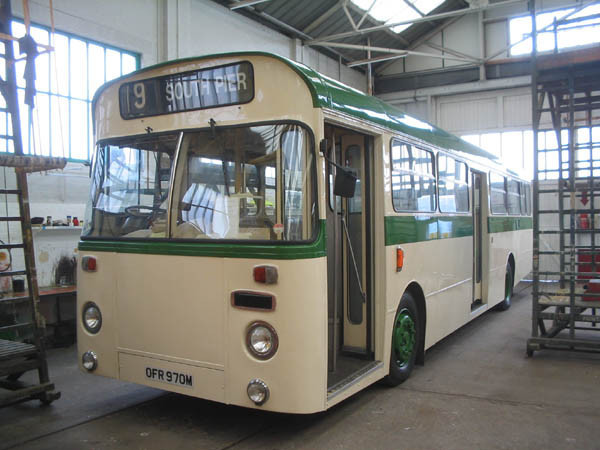
The first batch, 301-310 were followed by 311-330 in 1958 and 331-350 in 1959. Generally most new buses entered service on trunk routes such as the 11/11A, 14 and 22/22A and the PD2s became regulars on these routes, gradually cascaded onto quieter routes when newer PD2s, or later PD3s arrived. By 1969 the rear entrance PD2s were the oldest in the fleet and began to be replaced by new AEC Swifts, like our 570, designed to be operated by one person, yet accommodating the same number of passengers as a PD2. This bucked the trend as now the quietest routes had the newest buses.
The conversion to OPO operation was accelerated by the new Bus Grant which gave operators up to 50% off new buses. This meant that all the PD2s were withdrawn by 1975, most achieving only 13-15 years in service which was shorter than most previous buses (246 running for 18 years). Several were sold for further use and 3 were kept for ancillary duties from 1975. 334 and 337 were converted to mobile mess rooms for the tramway Permanent Way gang, replacing 246 and painted all-over orange, lasting until 1986 and 1988 respectively.
346 survived to the end of regular PD2 operation in March 1975 and then saw use, like its sisters as a mess room, but this time for the Illuminations Department. Active use ceased in spring 1982 but the bus remained stored until December 1985 when it was purchased by the North West Museum of Transport and moved to Burtonwood Airfield and later to St. Helens Transport Museum for preservation. Sister bus 334 was later secured as a spares donor.
Although tidy enough to be displayed for several years 346 was never restored and was declared surplus to requirements in 2005 as part of a review of their collection for display at their refurbished museum. 346 was acquired by LTT in September 2005 from the St.Helens Transport Museum collection and returned to Blackpool in December 2005.
Restoration work on Blackpool 346 started in the autumn of 2015.
Blackpool PD3 - 529
Blackpool’s half cab buses gained classic bus status towards the end of their lives, but in fact it was not until 1965 that Blackpool adopted this conventional double deck bus design. Prior to this the town’s buses were unique full fronted models such as Nos. 246 and 346 described earlier.
The half cabs came in two distinct batches between 1965 and 1968. Nos.381-400 introduced the type to Blackpool whilst 501-540 were delivered in 1967/8. Although the first to be withdrawn was in 1977, the type had relatively long lives with Blackpool Transport with the last examples operating in passenger service until November 1988.
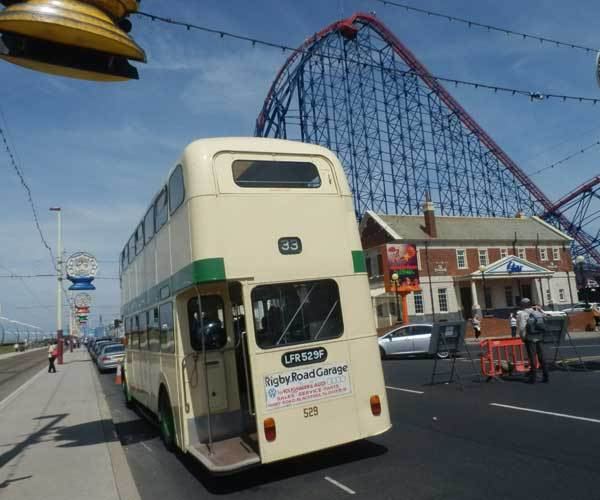
Blackpool 529
The 1968 batch of PD3s were largely withdrawn in 1980/1 and were replaced by a batch of 86-seater Leyland Atlantean buses. 529 was taken out of service in August 1980 with the arrival of a further batch of Atlanteans, including 334 that is now part of the LTT collection.
It was stored until July 1981 when LTT member Graham Oliver acquired it for preservation - the first Blackpool PD3 so purchased. It was modified to match the original livery and rallied for a few years.
Graham sold the bus in 1984 and it was kept initially in Blackpool then later in Burscough and more recently at St.Helens Transport Museum for restoration. 529 was sold back to Graham Oliver in 2001 and in 2003 it returned to Blackpool to join the LTT collection, passing into Trust ownership during 2005. Full restoration of 529 started in May 2006. The bus has been extensively repanelled and was repainted into original livery style during September 2006. 529 finally returned to the road in October 2008 for the first time since 1983 - an absence of 25 years.
529 has operated commercially on wedding hires for our sponsor company Catch22Bus since 2013 and occasionally on Sea Front service 21. In December 2017, the bus received a further repaint, with period adverts in the 1970s all-cream livery.